
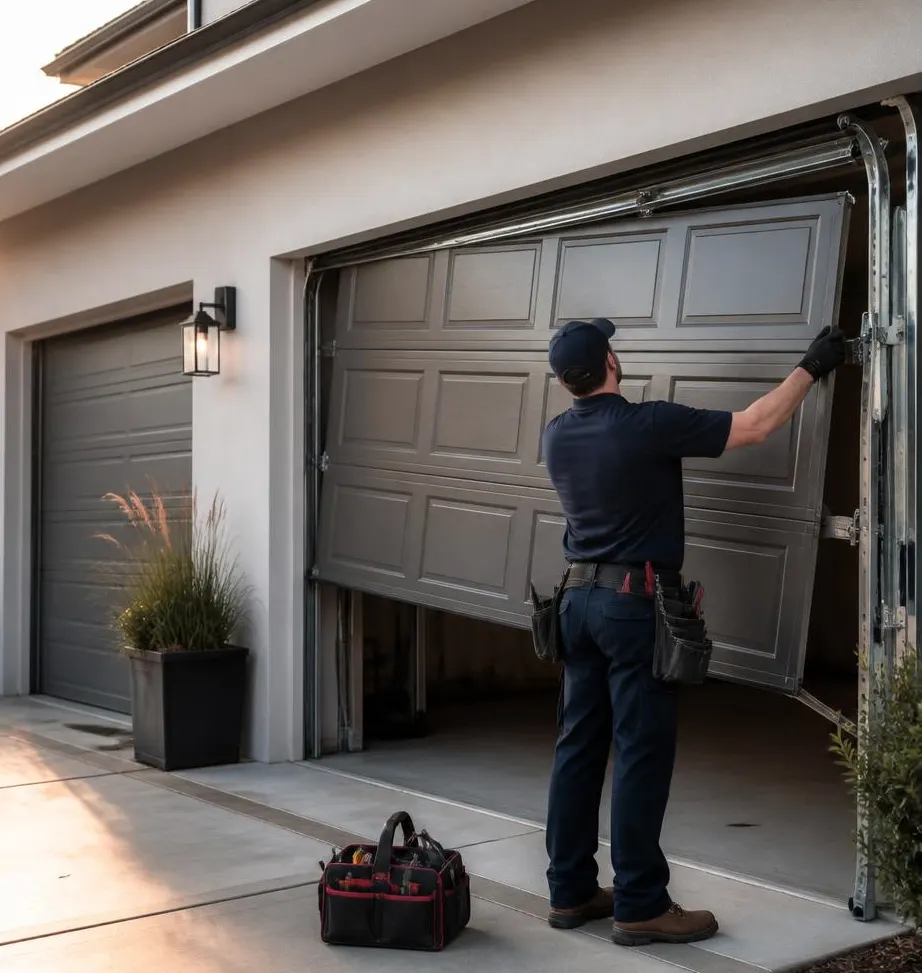
Rule of thumb: once each season, spend twenty minutes looking, listening, and lubricating your garage door — the moment a task involves springs, cables, or the opener's force settings, stop and call a technician. The exceptions: if your door is grinding, sagging on one side, off its tracks, or won't close all the way, don't wait for your next seasonal check. Those are signs of a problem that needs attention now, not in three months.
This routine matters more here than in drier climates. Salt air drifting in from the coast accelerates rust on hardware, humidity swells wood doors and door frames, and the heavy afternoon downpours that roll through from June into fall push water and wind against weatherstripping all season long. A quick seasonal pass catches small issues — a loose bolt, a cracked seal, a sticky sensor — before they turn into a Saturday morning call for emergency service.
Tools You'll Need
- Work gloves
- Flashlight
- Soft, lint-free cloth
- Silicone-based garage door lubricant (not WD-40, not grease — both attract grit)
- An adjustable wrench or socket set
- A short length of 2x4 or a sturdy cardboard box (for the safety reversal test)
- A stepladder
The 20-Minute Routine
- Walk the tracks. With the door closed, run your flashlight along both vertical tracks. Look for dents, rust spots (common near the coast and on doors that face prevailing wind and spray), or gaps where the track has pulled away from the wall. Minor surface rust can be wiped down; anything bent or pulled loose needs a professional look.
- Test the balance. Pull the manual release cord to disconnect the opener, then lift the door by hand to about waist height and let go. A properly balanced door stays put. If it drops or shoots upward, the springs are compensating incorrectly — this is a spring tension issue, and it's not a DIY fix.
- Reconnect the opener and run a full cycle while you listen. Grinding usually means worn rollers. Popping or banging can mean a loose hinge or a track issue. Note what you hear and where it's coming from; this helps a technician diagnose faster if you do need to call.
- Wipe down the photo-eye sensors. These are the small sensors a few inches off the ground on each side of the track. Dust, pollen, and the film that builds up from humidity can block them, causing the door to reverse for no obvious reason. Wipe each lens gently with a soft cloth and make sure both are pointed straight at each other — a bump from a stored bike or lawn equipment can knock them out of alignment.
- Lubricate the moving parts. Spray silicone lubricant on the rollers, hinges, and the springs themselves (a light coat on the outside of the coils is fine — do not attempt to adjust or remove them). Wipe off excess so it doesn't drip or collect dust. Do not lubricate the tracks; they should stay dry so the rollers can grip properly.
- Check the weatherstripping. Run your hand along the rubber seal at the bottom of the door and the vinyl strips along the sides. Look for cracking, flattening, or gaps where wind-driven rain could get through during a storm. If it's brittle or pulling away, it's an inexpensive, straightforward swap — most homeowners can handle replacing the bottom seal themselves with a kit from a hardware store.
- Tighten visible hardware. Using your wrench, snug up the bolts on the track brackets and the hinges between panels. Garage doors cycle thousands of times a year, and ordinary vibration works hardware loose over time. Stick to the brackets and hinges — leave anything near the spring assembly alone.
- Test the auto-reverse safety feature. Place your 2x4 or a box flat on the ground in the door's path and trigger it to close. The door should touch the object and reverse immediately. If it doesn't, stop using the opener until a technician adjusts the force and limit settings — this is a safety issue, not a convenience one.
What's Homeowner Territory — and What Isn't
Everything above — visual checks, lubrication, wiping sensors, tightening visible bolts, swapping weatherstripping, and testing balance or auto-reverse — is safe and reasonable for a homeowner to handle. What's not: adjusting or replacing torsion springs, repairing frayed cables, realigning a track that's pulled away from the frame, reprogramming opener force settings beyond a basic reversal test, or replacing damaged panels. Springs in particular are under enough tension to cause serious injury, and on wind-load-rated doors — which many homes in this area have because of hurricane codes — an improperly adjusted spring or track can also compromise how the door performs in high wind.
When to Call Precision Garage Door of Fort Myers
If your seasonal check turns up a door that won't balance, a spring that looks stretched or has a visible gap in the coil, cables that look frayed, or a track that's bent or separating from the wall, it's time to call. Our technicians handle Spring Replacement and full Garage Door Maintenance visits that go beyond what's safe to do at home — checking cable tension, inspecting the opener's internal settings, and verifying the door is still performing the way it should after a season of heat, humidity, and storms. If something fails suddenly, especially after a bad storm rolls through, our Emergency Garage Door Service gets a technician out to secure the door and get it operating safely again.
If your twenty-minute check raises any questions, or it's just been a while since a professional has looked at your door, give Precision Garage Door of Fort Myers a call. We serve Fort Myers, Cape Coral, Lehigh Acres, Estero, Bonita Springs, Naples, North Fort Myers, and San Carlos Park, and we're happy to take a look before small issues turn into bigger repairs.